

Why we stopped telling stories
A novelist echoes Sean of the South question
To: Sean Dietrich (@seandietrich)
Date: 17APR2026
Dear Sean of the South
I.M. Aiken (of the north?) here appreciating your YouTube post “The End of Homemade Music.”
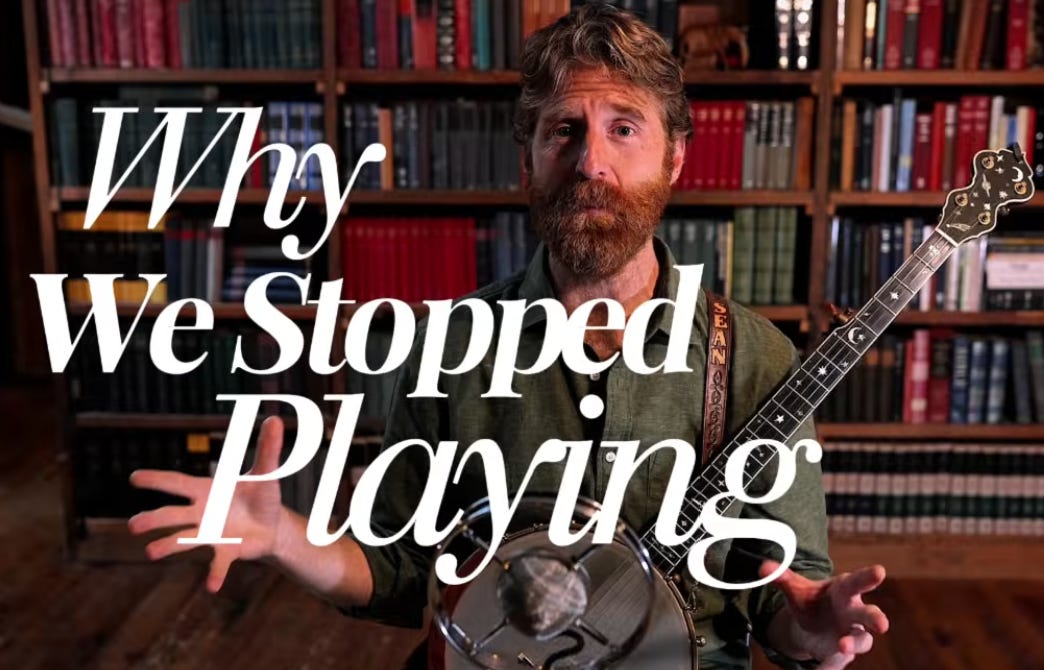
Between your team’s video and a video called “Before Air on Stephen Colbert” featuring Billy Crystal my own childhood memories of dinners and diners returned with nostalgic waves.
For a goodly while, I had peeks into the entertainment of my youth during occasional meals at the old farmhouse just south of us (a half-country mile, yet our properties share a long boundary). I knew, being invited to dinner there, meant I ought to “Play for my Supper.” I arrived with fresh limericks, small silly poems, sincerely good poetry (written by others) to augment the stories I am to tell at the table. “Tell” misleads the intent. I knew I ought to perform, from my chair. As dinner wraps and dishes scoot to the kitchen, the violins and violas come out of cases and get turned. Instead of the music of your stories, we listened to Bach, Bartok, Brahms, Mozart. Often played well given we had professional orchestral musicians in the crowd, but playing well, as you noted, was not the goal. The eldest of the fiddlers would guide and teach the younger. I loved her techniques for counting and queuing with a nostril flair and a breath.
That beloved host passed a few years ago at 99 years of age. Some of her music students became well-known separately from music and one recently returned to music after several successful novels. She was the glue to a community of performers and storytellers.
The bit with Billy Crystal on the Ed Sullivan stage carried me further into my youth and storytellers at the table. He affirmed his ability to tell a protracted story with character, plot, punch, laughs, and insights to the human soul. He recounted two stories of Milton Burle saying “I maybe the only person around to be able to tell these stories.” In the second story, he describes Uncle Milty sitting opposite Alan King. As those two swap tales, Uncle Milty makes gag faces at Billy over King’s shoulder at Spago in LA.
Whilst I am far removed from that world, I remember stories Alan King told in our living room and dining room near Boston. His presence was not extraordinary, nor his skills in entertaining with apparent off-the-cuff stories. They were not. Each story blended practiced narratives tuned to fit the setting and audience. As a seven-year-old child I sat at my parent’s table with giants and unknowns who fought for laughs and attention with stories and performances. Elbow up and squeaky voice I plowed in: tolerated and encouraged. When older, coached and criticized. “Well, I would have gone this way,” only to hear your deeply personal story reformed into something else by someone else. Theft is praise here.
One story I have carried with me since my 16th -ish year was told by the novelist James Grady. A lanky cowboy from Montana stood before my mother telling a story of his prom date, a story dubbed “The Which Tit Dance”. In an effort to remember which side his boutonniere was to be pinned on his jacket, his mom (play by Jim) stood her son (played by my mom) stepping into and out of foreign and forgotten dance moves to remember which tit the young lady’s flowers would be and which breast the man’s flower goes so as not to be crushed. Tear of laughter streamed from us all.
I re-read that story is a recent novel of his called “American Sky”, a quazi memoire. I read it with sadness missing the insanity and personalities of my youth. In print, it was less vivacious than when he held and danced with my mother. I guess that’s what we do. We leave them in print for others to read, later.
My poor mom would occasionally get squeezed between the younger burlier Stephen King and Robert B. Parker. Each guest at the table had equal rights to the audience. If you failed to hold your own, little mercy given. My surrogate grandfather and treasured neighbor, raised by German Jews in Brooklyn pulled the trigger on the tail gun of an American bomber while fighting the Nazis in WWII. A man with dozens of patents in the nascent computer industry and retired to paint elbowed his stories in as an equal—and he was equal to the tasks of entertaining.
Later, as a young sailor, working schooners on the New England coast, the crew told stories around the wheel during sunset. A practice that harkened back centuries and millennia. One skipper had a rule; a tough rule. If a crew member started a story and it was known, those who knew the story put their hands up. The rule was you must continue until the point when all hands went up. You felt the judgement with four hands up and two down. You rose to the challenge: adding color, pushing harder, dugging deeper.
Being raised in Metro Boston, I had the thrill of listening to Marshall Dodge and his compadres tell “Bert and I” to intimate audiences. Stories I would later tell, then reshape. There have been times in my 30+ year marriage when I joke “Just toss me back in”. Money tight, times uncertain, I would make a call back to a Bert-and-I story about the wife in a lobster-fishing marriage. She had fallen overboard. When later found by the Coast Guard with a hundred lobsters clinging to her corpse, Bert’s answer was “Well, bait her and throw her back in.” To me, a reminder that I gots a job to do. Sometimes, it is my turn to bring home the lobster (or bacon or cabbage).
As I enjoy your songs, you bring to mind performances by Stan Rogers, Gorden Bok, Bill Staines and that amazing cross over between singing and story telling before an attentive audience.
We had color television. At our dining table we enjoyed the son of a Choctaw chief, playwright, astrophysicist, textbook author (oh, right, just one guy). My father’s family had ancestorial connections to vaudeville, RKO, NBC radio, and writers going back over a century. My father, a novelist, had been raised by his father a novelist and the writer behind dozens of movies from the 1920s. This is how my family of people once knew how to “bring home the lobstah”.
Modern Americans may think of this as a “Salon.” I have attended a few. They ring a distant bell to the chaos I once knew. Salons appear tame to me. No, this was the equivalent to the back porch and cigar box banjo.
To this (once) youth, it was a training ground similar to yours. Instead of music, we laughed and danced to the sound of stories: accented, ethnic, refugee, oppressed, embattled, and loving.
Yes, Sean of the South, we are witnessing the loss of homemade entertainment. We are the worse for it. I force-marched through a few recent best-selling books lamenting the quality of the prose. I want rhythm in my prose. I want voice and sincerity in the tellings. I desperately wish that some of these authors got “beat up” and trained while standing to tell a story (sing a song, play an instrument). You learn how to pace a story, how to connect to an audience. You learn to laugh at mistakes and humble the f-out of yourself. You learn humility from the giants at the table who listen, laugh, then steal from stories told at your own table.
I hear the difference between storytellers and contemporary novelists.
To borrow the language of Borscht Belt comedians, you need to learn to die on stage then do it again. You remember the day you slayed your audience then do that again.
Thank you for bringing the back porch into my front parlour.
Yours from the north,
I.M. Aiken author & narrator
“The Little Ambulance War of Winchester County” (2024)
“Stolen Mountain” (2025)
“Trowbridge Dispatch” - fictional short stories/podcast
“Captain Henry: 2½ Insurrections, 2 Wars, 1¼ Centuries, and a story of Love” (2026)
Follow along at: