

Prior Articles
Part 2 – Quick Guide to Reaper
1. Setup
You’ll need a “studio”. It sure can be a soundproof booth. I work in my cluttered office but I’ve made efforts to soften hard surfaces: a bookcase on the rear wall, a 3-sided bay window, and my primary monitor is curved. I have pads on my desktop. No perfect, but good enough.
I need:
A chair I can sit in for an hour that doesn’t squeak, tick, click, or annoy me during edits. I sit in a hard-bottomed/hard-backed maple kitchen chair. I sometimes use a 5-wheeled padded stool. One is hard on on my ass, the other is tough on my back.
See and scroll my script (manuscript) in a size my eyes can see. I zoom and set full screen.
See and click on my Reaper screen.
Access to my mic so I can place it on the left-edge of my lips and part of my cheek.
I’ve gone through about a half-dozen configurations in 3 years. Still tuning.
I do have this massive monitor which I put script on left (mic is on left) and Reaper on right. I have 4 monitors on this computer, so I also put Firefox in one and my Proton Email in another.
2. Prep
Warm Up
Warm up your voice. You are about to perform for an hour. Sing scales. Talk loudly. Sing a song. Walk and let your body you’re doin’ this.
Avoid foods/drinks that cause mucus or dryness. Cranberry juice is mildly astringent, but cleansing for me. No milk or cream for me. Be hydrated and relieve your bladder before starting.
Clean Up
Clean your nose (yes, you just read that). Clear boogers, give it a good blow. Every breath sound shows on the tape.
Clear your mouth – no food residuals, fresh water, etc. You really do not want a clicking noise when you open your pie hole to talk to the mic.
Wear soft clothing and soft shoes (or barefoot). Belts, purses, jewelry, even rings can create sound. Empty pockets. Get comfortable.
Be Fresh
I am an early morning person. I can make a few fixies after lunch, but for me to tackle a full chapter after lunch or late in the day, is tough. I need my best energy for the performance. Know your own energy cycles and match them.
That said, I recorded “Stolen Mountain” with cough drops all over my desk and one stuck between the cheek and gum. But jeez, every time the cough drop hit my teeth, I had to cut that from the tape or re-record. I learned to break them. Take a small amount at breaks.
I recorded “Captain Henry: 2½ Insurrections, 2 Wars, 1¼ Centuries, and a Story of Love” with two broken wrists. I had had 2 surguries to reconstruct them and have internal fixaters installed under my skin. I was dealing with TBI issues. I was tough. I’ve had to re-do about five of 21 chapters.
Plan a Limited Scope
I can do 1 chapter on most days. My chapters range from 2000-5000 words. I try not to write chapter longer than 5000 words, given the effort it takes to record them. Plan small, start small until you find your endurance.
I record in 1 sitting. I then edit in the afternoon or a different sitting.
For me, I record, then edit in close proximity. Why? Because if I have to make fixies, I need the same environment, same voice, same, same, same; else the tape will tell me. My voice can change a small amount day to day.
Record in the Same…
Your mic will pick up the sound/dimensions of the room. Your voice changes based on posture. You need your voice to be pretty consistent for 10hrs or what ever the length of your novel is.
Be in the same room
Be on the same mic
Use the same settings on your amp and DAW
Be in the same chair
Put the mic in the same place, every time
Be Familiar with the Words
I know, you wrote it, how could you not know it? It happens. You do need to practice before hitting the mic. Read it aloud to yourself.
You are performing a script for an audience. Know your inflections. Have a plan for characters. I have a bit of range so with male characters, I go a bit deeper. For one, I’ll have a Elvis growl. For another, I have a breathier sound. My main character, Brighid talks faster and breaks the 4th wall all the time. I use my natural voice, but a bit faster and I am bouncier.
A practice run will save you from stumbling over awkward phrases.
Mute Everything
Kills Teams. Kill Outlook. Kill notifications. Mute your mobile phone(s). Turn off radios. Tell people that you are recording. You can not simply mute your computer because you need to hear the recording, so you do need to control the other stuff manually.
3. Recording Techniques
Lift 1 Side of Headset
There is often a delay between mic and headset that costs about 1-5 milliseconds as the digital sound goes from mic through wires to amp to computer back to amp then to monitor (headset). Yeah, sure speed-of-light [C] is a constant and wicked fast. But, the processing is the delay. If you lift one ear cup, typically the one opposite your mic, this delay is less annoying. Your brain blends the “wet” and “dry” sounds (you speaking and you hearing after computer).
Yup, a real technique. It also aids in not thinking you sound “odd”.
Volume Control
You will have to learn to start a sentence without “attack”. Most of us when starting a phrase, start loud then taper down. We are softer in the middle of a paragraph than the opening words. That extra silence and slight attack tells the listener that we’re on a new graph. That’s good.
When restarting in a graph, you must learn to match the “mid-graph” volume. There are editing techniques in Reaper where you can isolate a loud bit and reduce the volume. It takes time, also the attack can still sometimes be heard.
Trick 1
Learn to do it. Teach yourself and practice (yeah, hard work)
Trick 2
Start 1 or 2 sentences back, then roll forward to the bit you are re-recording. Then cut only that target bit and discard the louder attack at the open.
When I learned to walk on a stage as a kid, I was taught to start about 5 steps back on the wings. Your first step is always BIG. You want to walk on stage as your normal pacing. You need that technique here too.
Breathe Quietly, then Breathe Big
I can do quiet breathing for a page or so. Then I just need a little break. I don’t turn off the recording. I lean away from the mic (1-2 feet/ 0.5m) and breathe with big belly breaths. I might cough or give the schnoozle a honk. I’ll cut it later.
Lean back, put the mic on your cheek and start with a fresh paragraph.
Mistakes
You will make mistakes. Be dispassionate about them. You can not react with emotion. No throwing of proverbial tennis rackets or slamming piano lid. You need to remain at the same level emotional state before, during, and after a mistake. You’ll fix it. But tough to fix the emotional nonsense. You’ll find yourself re-recording a whole page. Get blasé about it. Find the “ho-hum” of it all. Be zen.
BEEP BEEP
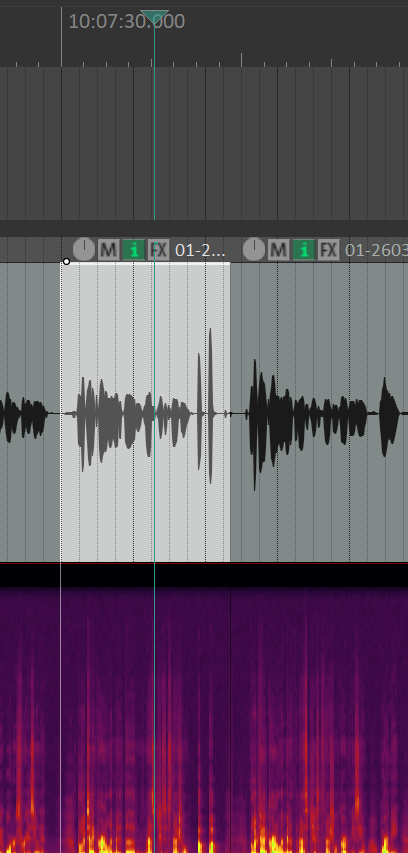
I make mistakes. You will make mistakes. Stop. Breathe. Then make an obnoxious “beep beep” or “boop boop” or “meep meep” loudly-ish into your mic. Some folks use a dog training clicker. I do not because I only have 2 hands. My right hand is on my keyboard for start/stop on my DAW (asterisk to start/space bar to stop – I may have set a short cut for the “*”). My left hand is on a mouse so I can scroll my script as I read.
You are putting a visual mark on your tape that you can rapidly find and fix. See image below.
Don’t Push/Don’t Rush
The friggin’ mic picks it all up. If you rush, you’ll hear it. Just stop. Breathe and take it again.
If you need to pee or poop, just stop. It won’t go away by sitting at the mic.
If you get tangled in a sentence or awkward phrasing, just stop. Keep the tape going, lean away, fix the words, then record it. You’ll hear the keystrokes on the tape. Just cut them later.
Emotions
My own writing can make me cry and make me laugh. I feels odd to laugh out loud at your own words. I call it good. I can hear me smile on tape. But I should not laugh.
With respect to crying, yes, I do that at my own work as well. Finishing the last chapter of “Captain Henry”, I hear myself at the edge of tears. I did have a few tough minutes. I leaned away from the mic, let the feeling hit, breathed, centered, then leaned back. I still wanted that froggy thickness in my voice. I didn’t cough or “walk it off”. I need to be in the same emotional state to finish the chapter with consistency. It is a balance. As a performer, I want to reader to get that clue from my voice, but I can’t afford to ham it up or go to a fully choked up posture. I need to teeter on that fine edge; just enough to hear it, not enough to mask the story telling.
Match your cadence to the story. If you hit a laugh line, let the reader hear it and give them a natural second to giggle on their end. They can’t hear you if they are laughing. They are there. If you were on stage, you’d know when to restart. You don’t want them to know you paused for the laugh-track, but you don’t want your next phrase to be lost either.
4. Editing
I take a full and proper break between recording and editing, but I do follow through on the same day in case I have to re-record after a flub. I need my fixies to sound the same as the original work.
I start at the top of the chapter read and listen at the same time.
Headset/Monitor On Both Ears
Unlike recording, put the over-the-ear headset over both years. You want to hear 100% of everything on the tape. You want to discriminate between sounds on the tape and ambient/background sounds. Let the “cans” do their work.
You are listening for natural sounds on the tape:
Mouth ticks
Nose whistles
The 2 ravens outside the window
The chair squeak.
You do (kinda) want the words on the page to match the words you speak. I never get this right. I am dyslexic. I miss. I’ve been told this is a BIG DEAL so I now appologize at the top. Some people listen to books while holding a printed or digital copy.
I strive to be darn close. You can control this. If you hear a word missing, you’ll likely have to re-record the sentence or whole graph.
Beep-Beep
The purpose of the “Beep Beep” is that it makes 2 tall spikes on the audio. I often have a bit of space near by. This tells me that I flubbed up and I am heading into a fix. I make a slice (cut, short cut key “s”) just after (right side) the 2 tall spikes.
Just after the 2 tall spikes, I restarted. I have learned that I ought to start at the top of a sentence and occasionally, the top of the paragraph. I can rarely catch just after a comma, semi, m-dash, but that’s hard to match the cadence.
Rookie Approach
Listen to the oopsy, roll right to and through the Beep-Beep, identify where you restarted. Then go back with the player head and find that on the left. Mark it with a “marker” or just slice with with a “s” in the flat space before the oopsy. With cuts on both sides, click that isolated “item” and hit delete on the keyboard. With Ripple On, it will self-heal. I sometimes slide a bit right to add a natural sounding space between the phases.
Advanced Approach
With a few years of looking at my own voice’s wave forms, I see patterns and words. I can sometimes identify the beginning of the oopsy by recognizing the wave form after the “beep beep”. If I’m really kickin’ it, I sometimes do this on the right of the player head and before I hear it.
There are RISKS.
A few control-z (undo) will get you back.
As you listen, it should be seamless.
The Solution for All
The answer to bad audio is to re-record. I redid Chapter 16 of Captain Henry because the copy edits and the original work drifted too far apart. I can sometimes find a moved sentence/graph and make the tape match the manuscript. The audiobook doesn’t care about spelling mistakes, punctuation, and such. And I tolerate the slight misalignment.
I redid Chapter 18 of Captain Henry. It was a horrible chapter that my editor and I tossed. I re-wrote it. But when I recorded it, everything sounded different. It was tinny. The sound was softer in a bad way. Garbage. I make sure all was same-same-same, and read it again. Now it is seamless. Glad I did it.
5. Listen Again
You do need to listen to the entire book again. I don’t have a brilliant way of solving this problem. My trick is that I load it to a professional podcast host (transistor.fm) as a private podcast. Only people with the link can listen. Then I can listen on my phone. I can also recruit beta listeners to participate. I love my peeps (family/friends) but they kinda suck at giving me feedback. Still waiting on ye olde spouse to finish Captain Henry.
What are you listening for on this go?
Consistency between chapters: tone, volume levels, sound quality
Chapters are in order, story telling sounds correct
That “beep beep” you missed, or the sentence you re-read without the “beep beep”
It is story-telling errors, continuity and consistency you are listening for. Your done with background noises, ticks, snot, and the little stuff.
If you do get someone to listen to your work, you want feedback about errors. You need to ask for chapter number, and minutes in (visible on a podcast). Also what was said. You can not search audio based on a text search in Reaper. You can click to a chapter and timestamp.
6. Closing Comments
This is a professional job. People win Tony and other awards for their performances. Your performance will land on a spectrum between “Tony Award” and dead-flat-stupid AI voice. With each effort, you will improve. Be patient with yourself.
One day 1, AI may be slightly better than you, but I’d rather listen to a human. I turn off AI narrations where I find them including YouTube and such. Although with 2 broken wrists, I did let the New York Time dreadful AI voice read me articles when I laid up.
Your skills will improve with training and practice.
Do this primarily because you want to. Do it because you believe that your performance as an author will be better than another’s approach.
I am presently listening to Louise Erdrich read her “The Night Watchman” to me. It is great and better than a “paid” performer given her connections to the culture, lands, and material in her novel.
I remember listening to Barbara Kingsolver’s sister read “Prodigal Summer” to me. I appreciated that southern Appalachian twang in her voice. I also LOVED the producers decision to include native bird songs in transitions with sections.
I recently listened to Saskia Maarlevald read Kate Quinn’s “The Astral Library”. I love Saskia’s readings. But as a native of Boston, I wanted to climb through the internet to coach her on local pronunciations of neighborhoods and landmarks. It instantly told me she (Saskia) had never been taught how to say some of our odd stuff here. Just a 10 minute primer would have help me remember I was in Boston while listening. We do weird stuff with words here: Worchester is: “wh-stah”; Gloucester is “glah-stah”.
Watch your own writing change
I’ve written 4 novels since 2020 (recorded 3, the 2028 novel sits waiting). I’ve written and recorded over 20 of my short stories. My writing has changed due to my reading of my work to tape.
If I can’t say it comfortably, I won’t write it.
I write sentences that let me breathe.
I use words I can say; which often lands me deep in Anglo-Saxon/Old English rooted words.
Progressively I see myself writing more with a preacher’s patter or Winston Churchill-like style. I let the sound and rhythm of the spoken word help deliver the story.
I’ve learned to avoid sounds and word combinations that cause me to trip or stumble in my speaking.
Honestly, I think more about the audio performance than the look on a page.
Added Lessons About Audio Story Telling
People listen to me while doing other things: exercising, cleaning, driving, walking in nature, relaxing before sleep in the dark. I am primary-ish in their brain as their body does something autonomously. But people get distracted when listening in a way that doesn’t happen with print. With print you look up a graph or flip a page back. People don’t like hitting the 30-sec back button.
I am noting an influence of this in my writing.
I never bury a major plot turn or scene change without support. I hate blinking away then sensing I am in a new place or something major happened and I lost only 10 seconds.
I add silent space to help people understand transitions. Instead of an asterisk or extra-carriage returns, I add a silent pause.
I don’t mind a little repetition in my narration. My editor has said, “You just said that five pages ago.” In audio, that can be a day ago, or minutes ago.
I endeavor to make sure that context exists or easily inferred quickly within a page.
There was a book I listened to last week where the author jump POV repeatedly within chapters. The narrator didn’t adjust voices. I kept going “where the f am I”. I’d roll back and back and back to find that transition. Ugh.
I was also listening to an older Bernard Cornwall book this month and the chapters all seem to be 50-58 minutes long. I started wondering if the long pauses within the audio “chapters” were in fact the printed books chapters, but unnumbered and untitled. The producer made sure that audio files were less than 60 minutes. So Annoying!
As such, my chapter structures match how I want to listen. No big scene changes, no POV changes, about 20-40 minutes, each chapter has an open, middle and close.
I.M. Aiken,Author & narrator
“The Little Ambulance War of Winchester County” (2024)
“Stolen Mountain” (2025)
“Trowbridge Dispatch” - fictional short stories/podcast
“Captain Henry: 2½ Insurrections, 2 Wars, 1¼ Centuries, and a story of Love” (2026)
follow along at