

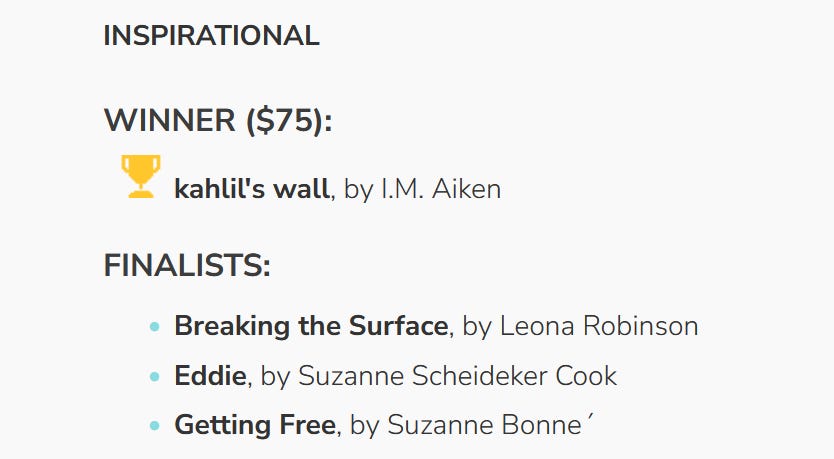
Kahlil’s Wall is a short story written for my Trowbridge Dispatch series which is now (will shortly be) in the 2026 Next Generation Short Story Award anthology. Once we’ve followed all of the rules and promoted their publication, I will make the print and audio version available again on Substack and likely in a future print/ebook/audio book anthology of my own short stories. I don’t often take notes after a story.
- I.M. Aiken 18 MAY 2026
10 June 2025
I wrote “Kahlil’s Wall” yesterday after thinking through the story for days. Technically, yesterday I wrote “Frost’s Wall”, I renamed it after a morning swim and some think time. Making laps on a dark cool June dawn, I inventoried the elements that triggered the story.
Watching fellow Vermont’s preparing to pour a concrete slab,
Watching, and fussing at, a Hitchcock movie,
Listening to the executive branch of our federal government tell me how we must formulate our military as we simultaneously call Marines and state National Guard troops into our city streets,
Remembering that 20 years ago this month Uncle asked that I stop what I was doing and fly to Texas to join division of 20,000 soldiers and a tiny handful of civilians,
And thinking about the meaning of Pride Month.
On my desk, as I write, is my pocket copy of The Declaration and Constitution, the same copy I carried in Iraq. Just under it is a postcard from an author who wrote a book called Delete the Adjective about her accomplishments in the US Army, including being one of the first women to graduate the Army’s elite special forces training programs.
The Ingredients
Pouring Concrete
Two weeks ago, after having torn a garage from our Vermont home, I watched a long-time friend and neighbor sit within feet of the metal tracks of a large excavator. He was completing a task that involved sealing a pipe that we placed into the stone. His friend would lift crushed stone from a pile, swing it over his friend’s head then place it precisely on a target as direct by a third guy. Had health-and-safety experts been present, we would have been shut down. No hard hats, no steal toed shoes. “D” actively working below a moving and full bucket. How wrong the experts would have been!
The work was rendered safe by decades of experience and the ability for this crew to communicate needs and movement silently. With a look and a nod, messages passed.
I had just written a short story called Murmuration (A Trowbridge Dispatch story) that explored this non-verbal team work. I thought: done-and-dusted. I can’t tell that story again.
But can I?
Hitchcock Movie
After watching the requisite D-Day movies on a stormy June 7th (one day late). Still stormy, I clicked to “The Man Who Knew Too Much”. A few scenes really bothered me. Sure, I appreciated how Hitchcock developed tension and I can appreciate the modest special effects of the 1950s. Sin #1, the Arabic spoken was gibberish. Sin #2, hubby drugged the shit of his Doris Day wife after their son had been kidnapped. WTF? Sin #3, the production crew used up an entire scene making fun of Arabic food and customs.
What do we miss when we fail to explore and understand each other.
We need to share customs, language, understanding, and more.
Yes, eating with three fingers of your right hand and keeping your left hand away from food makes a ton of sense. If you can’t figure that out, think: e-coli and the world before bears started using Charmin to wipe their asses.
I took classes, and like so many other army classes, it was structured, formal, involved slides, and a few questions on a test. I took classes on advancing-against-direct-fire and advancing-against-indirect-fire. I demonstrated my ability to do a low crawl and high crawl. And I took the class on basic cultural differences.
None of that mattered when I found myself at the table with my boss, a major, sharing bread, coffee, and treats with Iraqi leaders. I don’t drink coffee, hate the stuff. It isn’t about the left hand and fingers, it is about manners and an understanding why people sit together around a table. In our case, each party there wanted something from the others. American military working to please and gain favor from Iraqis who were in turn striving to please us and gain our favor. No two-hour class on a linoleum floor near Killeen, Texas prepared me sufficiently for that experience.
That ended up being part of my duties. I worked as a civilian technical expert who travelled to local vendors and markets for the supplies our tiny unit needed. Negotiate, smile, carry cash, protect yourself, have an exit plan, commit to the process, respect and smile more.
My Arabic is terrible yet I tried. I am a focused, determined and an unapologetically Yankee woman who appeared out of place in Baghdad and Takrit and all the other places we travelled to and worked.
Modern U.S. Military
I like to comment that my family’s never really missed a chance to go to war. On my mother’s side, I found historical documents of King Jackass telling Baronet Fussy-bottom to loot and shut down a local monastery. There you go, the King of England told a local baron to oppress the Catholics because by the Grace of God we’re protestant (that week anyway). My mother’s family came over on the Mayflower. The mythology is that those folks were a bunch of religious whackos who landed settled in a Native American Village a few years after a European plague killed off the residents. Even with all the advantages of English might, God, and such, 50% of these Mayflower folks got dead.
My ancestor served Plymouth and the Massachusetts Bay Colony as a warrior. Someone needed to carry a sword and blunderbuss, that was my guy 11 generations back. In his obituary, it read, “He found god in his 84th year,” then croaked. The record has him thumpin’ heads for 70 years. My family fought on both sides of the American Revolution. And with pride, I state that all of my ancestors who served during the Civil War were all members of the U.S. Army and served in the 2nd Massachusetts Infantry Regiment. One of my great grandfathers lead troops in Cuba during the Spanish American War. We didn’t skip WWI nor WWII. I got an uncle who served in various intelligence roles. He graduated from a military academy in 1945. He ran super secret stuff during his three tours of Vietnam. One of my cousins got whacked by Agent Orange, then later by drugs on the streets of Boston and Cambridge. We missed one or two invasions into Mexico, Haiti, and the shindig in Granada.
I’ve loved and appreciated what the U.S. Military has come to stand for with respect to diversity. Oh, what an evil word today. We must understand languages, cultures, people, and history. Diversity is strength. Diversity is resilience. On every front, diversity is resiliency: agriculturally, we’ve learned the adverse impact of monoculture. Biologically, diversity protects us from disease.
To look at external forces trying to shape the American military into some fictional WWII stereotype must fail.
We want female soldiers. We want queer soldiers. We want Muslim and atheist soldiers. We want Catholic and Protestant soldiers. We want short soldiers and tall ones. We want some soldiers to be a crack shot and other soldiers to be scroungers and negotiators. We need gamblers and chess players. We need jazz-piano-playing soldiers. We need our soldiery to be exactly like us; overflowing with messy messes. At one point during “sergeant’s time” when I was training the world’s geekiest soldiers, one new private asked her sergeant, “I was told to bring all of my weapons to the armory.” With reverence she handed him a stick. Fair enough, a staff. A beautifully shaped and colored staff. It had been hardened by fire.
In all sincerity, the sergeant looked at the young witch (wicca) and said, “I think we were really talking about your rifle, private.”
No doubt my friend had a good giggle later about a young woman handing him a stick to lock in the unit’s gun armory.
Don’t you giggle either. A fire-hardened staff is an effective and lethal weapon. And if you doubt me, watch any YouTube about bootcamp and watch young soldiers whack each other over the head with puggle sticks.
There are two things that all members of the military know and must embrace at all times.
#1 - The oath is made to the words printed in our Constitution.
#2 – Every soldier is required to follow all legal orders.
Parse that second one out and turn it around. That statement also means that it is criminal for a soldier to follow an illegal order. The law matters, always, even in combat.
June 2005
I had been deep in the belly of the Department of Defense. I already had clearances and IDs. I had already travelled the globe and written scores of articles as a technical expert. I had been accepted as a member of two units, one Air Force and one Army. Don’t tell the USAF team, but my heart was always Army. The USAF assignments were amazing and fun and well, not for the telling. My little army team invited me to participate in team sports and show up at dawn on Tuesdays for Sergeant’s Time (training time for soldiers).
But I was home in New England. I’d popped up to Fort Drum a few times in my reduced role. My mother was entering the end stages of cancer and my spouse was about to retire after 25 years of teaching.
In August of 2005, I packed a small bag and flew to Texas. The dates are baked into my brain, as was the heat. In 2005, I had started the year in Alaska and during that year, I had travelled to military bases north of Fairbanks. That had me out and walking in temps that hovered near -40F, which the rest of the world is also -40C. Cold. By the time that year ended, I had acclimatized to work outdoors at 120F (50C).
And yes, like my fictional hero Sarah Ann Musgrave, I spent time in Takrit Iraq.
One of the young soldiers in our tiny half-platoon picked a lemon from a tree in Takrit. Our sergeant said, “Boy, see that building, that wall and that house?”
“Yes, Sar’n’t.”
“That’s the home of Chemical Ali. You sure you wanna eat that particular lemon?”
“No, Sar’n’t.”
Pride Month
My posse of characters fit all over spectrum that is humanity because that is what I know. The philosopher says: Write what you know. I wish that this story highlights the difference between queer soldiers and not-queer soldiers. I grew up in a world where everything about being queer was coded and obscured. You’d ask a friend, “Hey, is she family?” Code for queer.
Sound odd during Pride Month to say this. I shall anyway. The least interesting and least important thing about Sarah Ann Musgrave is that she is queer. The point is to make queer just part of the fabric of our community. Pull down the us verses them bullshit.
The Goal
Tell a story of teamwork but pull it away from Vermont.
Carry Vermont into the setting
No off-ramps, explain little
Celebrate people
Feel something
The Process
I wish I understood process better. I put the ingredients into my head. I sleep a bit. I try out scenes. I write a draft. It is magic. I write, type, think at concurrent speeds. I think about food (often). More accurately, I think about cooking. We bought a new countertop oven this recent week. It includes an air fryer. After quick success with potatoes, I tried a fried chicken. What a fail. What a mess! Who cares. I also made stock from the carcass with a lovely sofrito. When the fried chick failed, I made my mother’s chicken salad. In the chicken salad and stock, both, the secrete is to layer flavor on flavor. I made brownies this week. I ground black pepper, a shake of paprika, and a dusting of cinnamon went into the batter. I love layers.
Writing is cooking.
As the letters appear on the monitor, you grab something new to toss in.
Surprise
The behind-the-scenes of Kahlil’s Wall is longer than the short story.
Call to Action
Go buy books and anthologies written by people
Keep doing your creative work
Think about subscribing to my stories at https://TrowbridgeDispatch.IamAiken.com/
thank you
So glad you shared this 🖋️📜🕰️